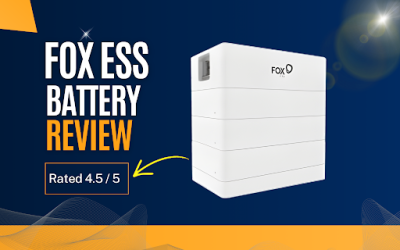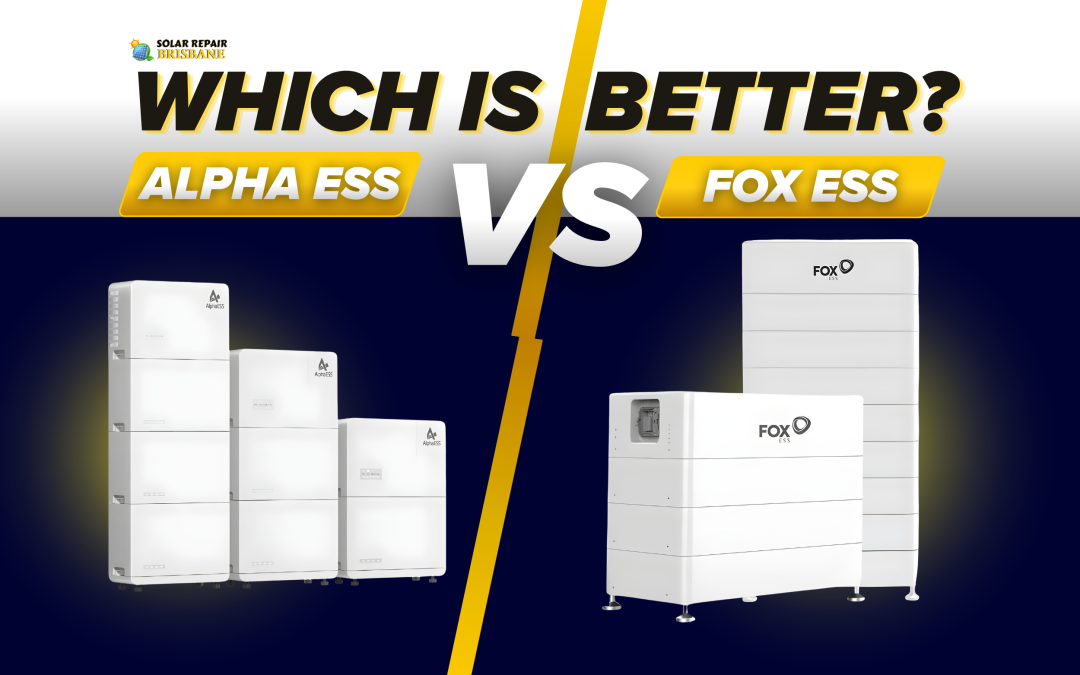
If you’re cross-shopping solar batteries at the moment and keep landing on these two names, there’s a very good reason for that. Alpha ESS vs Fox ESS is one of the most common comparisons Australian homeowners are making lately – and why? People want solid LiFePO4 performance without paying Tesla-level prices, so it really is perfectly understandable. Both are Chinese-manufactured, both have built genuine local track records, and both sit firmly in the value-focused middle of the market. So how on earth are you going to be able to pick?
Here’s how they actually stack up in a direct head-to-head:
But first, a quick bit of background
Alpha ESS has been in Australia since 2015 and was the most-installed battery brand by volume in 2022 and 2023. The company has offices in Adelaide and Sydney with local employees and technical support.
Fox ESS, on the other hand, is the newer entrant – founded in 2020, added to the Forbes Global Unicorn list in 2023, and growing fast on the back of aggressive pricing and a rapidly modernising product range.
So in our head-to-head, one brand has the runs on the board, but the other has great new momentum and some genuinely newer engineering. As we consider the Fox ESS battery vs Alpha ESS battery in a direct head-to-head, let’s break it down category by category, starting with the one most people care about first …
1. Price
Fox ESS battery vs Alpha ESS on price is close … but Fox generally edges ahead on raw affordability.
Fox ESS systems in 2026 typically cost roughly $832 per usable kWh installed, while Alpha ESS averages around $1,025 per usable kWh based on installer network data. In practical terms, a mid-size 10kWh system from either brand lands somewhere between $9,500 and $14,000 installed before rebates, with Fox ESS more often appearing at the lower end of that range.
VERDICT: Fox ESS generally wins on sticker price, but the gap narrows once you factor in installer markup and your specific configuration. Get like-for-like quotes before assuming either brand is automatically cheaper.
2. Warranty
Alpha ESS now offers a 10-year warranty covering manufacturing defects, with a performance guarantee that the battery retains 70% usable capacity after 10 years or 3.12MWh of throughput per kWh of capacity, whichever comes first.
Fox ESS matches that 10-year term on its established EQ4800 and EP11 series, but its newer CQ6 series – launched in January 2026 – carries a 12-year product and performance warranty. That’s a genuine step up if you’re considering Fox’s latest hardware specifically.
VERDICT: Roughly even on the older model ranges, with Fox ESS pulling ahead specifically on the CQ6.
3. Battery chemistry & safety
Both brands use LiFePO4 (lithium iron phosphate) cells, the safer and more thermally stable chemistry that’s become the Australian standard for home batteries – both perform well in our climate and carry a lower fire risk than older lithium-ion chemistries.
Fox ESS has pushed further on this front with its CQ6 series. The CQ-series includes a built-in aerosol fire suppression device that activates thermally at 170°C – a feature Alpha ESS doesn’t currently match across its range.
VERDICT: Both are safe, reputable LiFePO4 systems. Fox ESS’s CQ6 has a slight edge with its added suppression hardware, but this is a minor differentiator rather than a dealbreaker either way.
4. Capacity & modular flexibility
Alpha ESS battery vs Fox ESS when it comes to scalability is close, and both brands clearly prioritise modular expansion as a core selling point.
Fox ESS’s CQ6 scales up to 83.86kWh per stack using 5.99kWh modules, with up to three stacks in parallel for a maximum of 251.58kWh when paired with the right inverter – genuinely substantial capacity for larger homes or properties with heavy usage.
Alpha ESS’s residential range covers 3 to 10kW per unit, with models like the SMILE T10 sitting around 10kWh and larger configurations available for higher-usage households, though generally on a smaller individual-unit scale than Fox’s top-tier hardware.
VERDICT: For genuinely large-capacity needs, Fox ESS’s newer hardware has more headroom. For typical family homes in the 10-14kWh range, both brands offer comparable, well-proven options.
5. Track record & local support
Alpha ESS pulls away a bit here. Why?:
- A decade in the Australian market
- Local offices
- High installation volume.
On that last point, it means that most experienced solar battery installers have handled dozens of Alpha ESS jobs without surprises. Fox ESS is growing quickly and has shipped close to 100,000 units globally, but its Australian-specific track record is shorter, and as one independent reviewer noted, the long-term local support history simply hasn’t had as much time to prove itself.
VERDICT: Alpha ESS wins on maturity and proven local support. Fox ESS is closing the gap quickly, but is still the newer name in the room.
6. Installation considerations
One practical detail worth knowing: both brands are predominantly DC-coupled, meaning you generally need a compatible hybrid inverter from the same brand.
Why does this really matter? Well, if you’re retrofitting a battery onto an existing solar system with a different inverter already installed, either brand may require additional inverter work. So it isn’t really a point of difference between them.
Alpha ESS, however, does offer an AC-coupling option via its SMILE5 inverter, which gives it a slight edge specifically for retrofit scenarios where avoiding inverter replacement is a priority.
VERDICT: Roughly even, with a small edge to Alpha ESS for retrofit flexibility.
So – Alpha ESS or Fox ESS?
Our Fox ESS vs Alpha ESS battery comparison doesn’t give you one universal winner – it really comes down to what you’re optimising for.
Choose Alpha ESS if you want:
- A brand with a long, proven Australian track record
- You’re retrofitting onto an existing solar system
- You simply want the lower-risk, well-established option.
Choose Fox ESS if:
- Price is your primary driver
- You’re after genuinely large-scale capacity for a bigger home or future expansion
- The added fire-suppression hardware on the CQ6 series appeals to you specifically.
Both, though, are CEC-approved, both use safe and proven LiFePO4 chemistry, and both are eligible for the federal Cheaper Home Batteries rebate. Neither is a bad choice – the right one depends on your specific home, your budget, and how much weight you put on a brand’s track record versus its latest hardware.
Get a proper comparison for your property
Specs on a page only tell you so much. The right battery for your home depends on:
- Your existing inverter
- Your roof
- Your usage patterns
- Your budget.
As you can tell, it really depends on you. Solar Repair Brisbane can assess your setup and give you an honest, no-pressure comparison between Alpha ESS, Fox ESS, and other major brands.
Call today or request a speedy quote online.